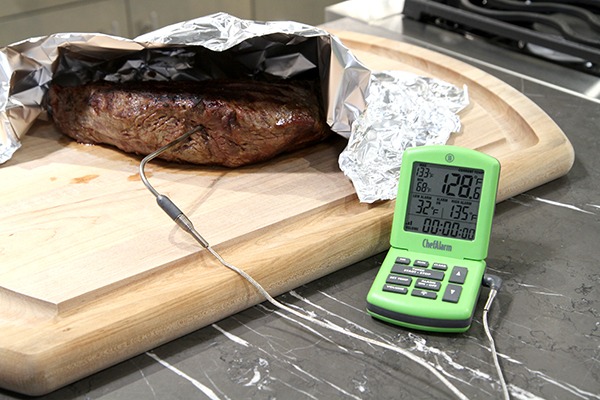
A very important step in cooking meat happens after it’s taken off the grill, or out of the oven. A couple of things are happening while your meat is resting, and it’s important to know exactly what those are so you can account for it and have the best possible result every time.
After cooking and before slicing and serving meat should be allowed to rest undisturbed. During the cooking process, protein fibers uncoil and then coagulate, recoiling and becoming firm. As the protein molecules become firm they expel the moisture that was previously held in their cell walls. While resting, the protein fibers are able to relax and reabsorb some of the moisture that was lost.
Cooked meat should be allowed to “rest” after cooking and before cutting. This permits the juices to be reabsorbed into the fibers of the meat. If you skip resting, you will lose more flavorful juices when the meat is cut. The internal temperature of the meat will always continue to rise a little during the resting period, so you should remove your meat from the oven or grill prior to reaching its target doneness temperature. Otherwise, it will be overcooked. Knowing the amount of heat rise during resting takes some experience. Generally, the larger the mass of the meat, the more the temperature at the core will rise during resting. This carryover cooking is due to the latent heat that is already traveling through the meat toward the cooler center.
Covered or Uncovered Rest?
How the meat rests will affect the carryover cooking. If the meat is left uncovered, removed from its roasting pan, or a hot steak is placed on a cold surface, more heat will transfer into the room and less heat will reach the center of the meat. If too much heat escapes, the meat may grow cold before serving. On the other hand, if the meat is kept warm in a low oven or under a heat lamp, there will be a larger heat rise and the center may be overcooked the center unless this dramatic carryover cooking factor is taken into consideration with a lower pull temperature.
“Tenting” with aluminum foil will conserve some heat and still allow some air circulation to avoid steaming the meat surface. Use extra care if you want to preserve a crispy exterior on a turkey or roast. A warmed oven (with the heat turned OFF) is a great resting location for meats with a crisp crust.
Typically, even a small steak, individually cooked piece of chicken, or a hamburger will rise at least 3-4°F degrees during resting. A larger roast or turkey can rise as much as 10-15°F depending upon conditions. The doneness of meat is directly related to the final internal temperature it reaches after resting. Knowing when to pull meat from its heat source is critical to the quality of the finished product. Learn how much rise to expect by taking readings before and after resting with your Thermapen®. Start deducting typical resting “rises” from your final target temperature when you remove your meat from the cooking surface.

Tamra Roloff says
I live part of the year at 8300′ elevation. How should I adjust the temperature for this elevation?
Tim says
That’s pretty high, where are you? Depending upon barometric pressure, of course, water boils well below 200°F up that high. There is some moisture in meat that affects its cooking temps but not enough to dramatically change the target temps (see http://www.thermoworks.com/blog/2010/10/chef-recommended-tw-approved/). The BEST thing to do would be to use your Thermapen to start taking readings in your meat at elevation and make your OWN guide for exactly how you like your meat cooked…