
Ensuring that Your Commercial Dishwashers
Will Pass Health
Code Inspection Every Time
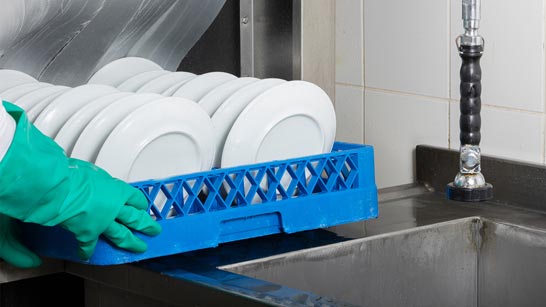
One of the most commonly misunderstood food safety measurements in the restaurant industry is demonstrating food safe dishwasher temperatures. From restaurant managers and owners to health departments and auditors, there always seem to be lots of questions about what the requirement is and how it should be implemented. This white paper will help you understand the challenges and some of the best solutions available to your organization.
The Requirement
The U.S. Food and Drug Administration (FDA) Food Code specifically states that…
“Hot Water and Chemical-Methods Sanitizing Food-Contact Surfaces…[must achieve] a utensil surface temperature of 71°C (160°F) as measured by an irreversible registering temperature indicator.”
Even though this seems clear enough, many operators are still confused about how to achieve the 160°F “surface temperature,” and more importantly, how to document it for health inspectors.
Here are some facts and tips that will help you understand how to properly measure and document your dishwasher temperatures and make sure your outlet passes each and every commercial dishwasher health inspection.
Fact 1: Utensil Surface Temperature ≠ Dishwasher Water Temperature
Although they are all present within the same dishwasher at the same time, your dishwasher’s ambient temperature, your dishwasher’s present water temperature, and the actual “utensil surface temperature” in your dishwasher described in the Food Code will almost certainly vary.
Fact 2: Many Factors Affect the Actual Utensil Surface Temperature
Many variables can affect the actual temperature of the water as it makes it way from the water heater in your dishwasher to the surface of the dish needing to be washed. Some of these variables include:
- the accuracy of your dishwasher thermostat
- the efficiency of your dishwasher
- the ambient temperature of the room
- the size of the dishwashing chamber
- the distance between the rinsing nozzles themselves and the dishes being washed
- the frequency of dishwasher use
Differences in temperature within the same system are called gradients. Just because the water is hot enough in one location in the dishwasher does NOT mean it is hot enough on the surface of the dish. Sanitization is achieved by the rinse water bringing the surface temperature of the dishware to 160°F (71°C) and holding it at—or above—160°F (71°C), for at least a few seconds, so that is what needs to be measured and documented.
Some Common Approaches & Their Drawbacks
Common Approach #1: Simply Turning Up the Dishwasher Temperature Is Ineffective
Because of the complexity of dishwasher systems, simply increasing the water temperature on your dishwasher is no guarantee that your dish surface temps will be in compliance. Many operators think they can do nothing more than set their dishwasher thermostat to 160°F (71°C) or, better yet, 20 or 25 degrees above the required temperature, say 180° or 185°F (82° or 85°C), just to be safe.
But food safety is too important to just guess that your water temps are high enough to sanitize your dishes. And State Health Inspectors will demand proof that your actual dish surface temps are within code.
Common Approach #2: Pocket Digital Thermometers Don’t Measure Surface Temps
One of the most common ways people have tried to document internal water temperatures in the past has been to throw a pocket digital thermometer into the dishwasher. As affordable waterproof pocket digitals have become more commonly available, this method has gained popularity. But there are some important drawbacks:
- You need to be sure you purchase a pocket digital that records a MAX temperature reading so you can see how hot the rinse cycle actually got before cooling down and before you have a chance to check the reading.
- More importantly, pocket digitals only record the temperature at the very tip of their probe where the sensor is lodged. And the likelihood that the probe tip is anywhere near where the dish surface is very low.
Common Approach #3: Disposable Test Strips Are Unreliable and Expensive
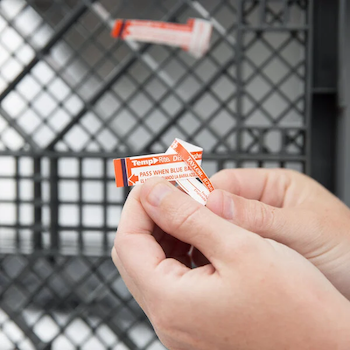
More and more restaurants have taken up buying disposable test strips. These are small strips of paper that have been chemically treated to change color at the target Food Code sanitization temperature of 160°F (71°C).
The key benefit of this method is that the test strip actually affixes to the surface of the plate or cup itself and measures the temperature where it needs to be measured. However, test strips have some serious drawbacks, as well, including:
- Test strips are hard to affix. They can easily fall off and become useless in recording dish surface temps.
- They can become “fouled” before use by being exposed to a heat source in a busy kitchen or in storage (like a truck bed on a hot summer day).
- They are not reusable and, therefore, have to be constantly replenished causing headaches for your inventory manager who should be focusing on food stores.
- Although they don’t cost much individually, multiplied across the many weeks of the year and, in many cases, multiple dishwashers in multiple locations, the cost of test strips adds up quickly as an ongoing expense.
- Individual test strips are prone to accuracy problems and can show false positives and false negatives.
Exciting New Approach: Reusable Plate-Simulating Thermometer

Recently, the leader in commercial-grade temperature tools, ThermoWorks, has innovated a new solution that cuts through many of the disadvantages of other methods. It’s called DishTemp®.
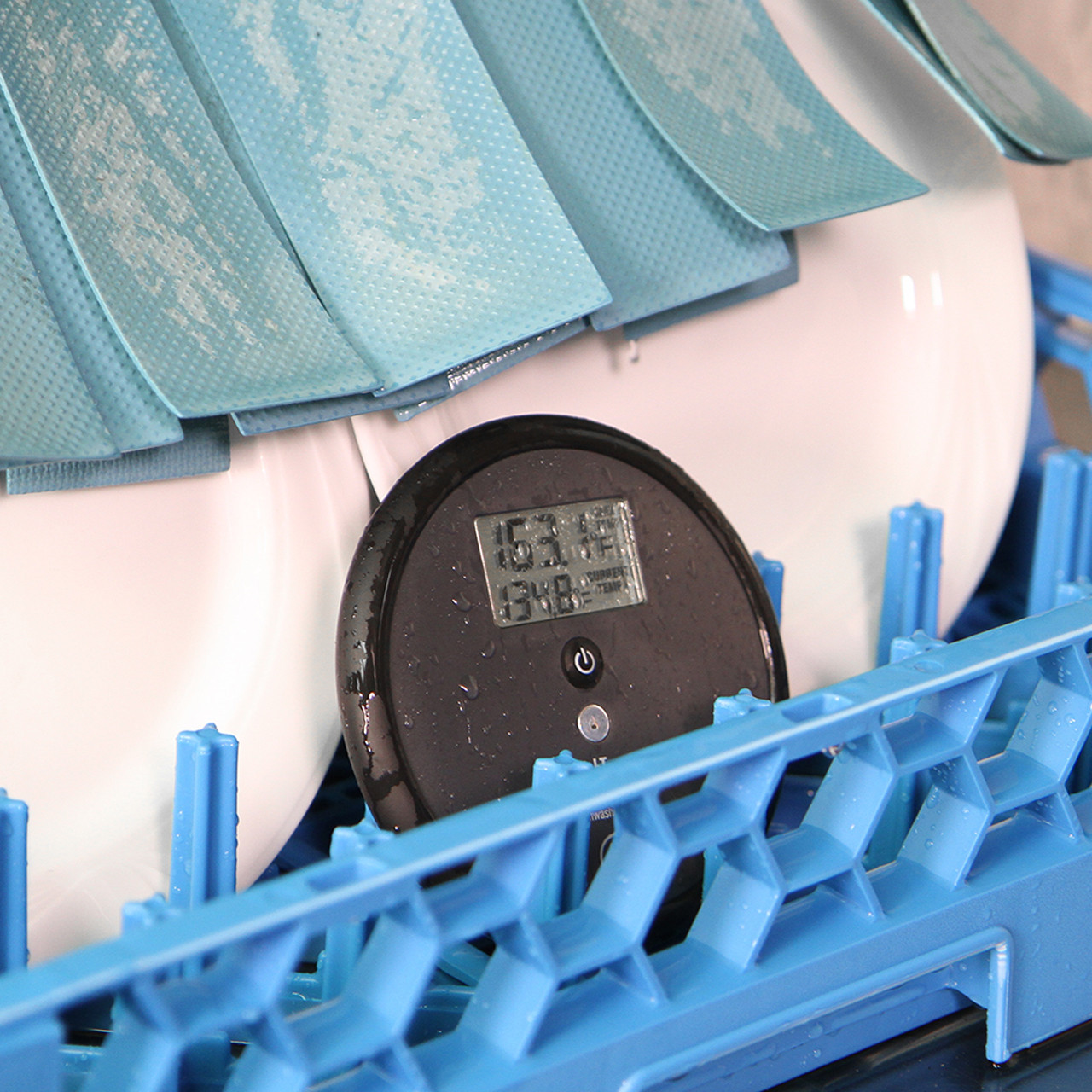
DishTemp is a digital thermometer that is actually shaped like a plate! Such a simple idea, but one that is remarkably effective. Simply set a DishTemp plate-simulating thermometer in your dish rack along with your other dishes and run it through each dishwasher. DishTemp records the MAX temperature experienced by all the dishes during the rinse cycles.
Each DishTemp unit comes with its own NIST-traceable certificate verifying its accuracy to ±0.9°F (±0.5°C). DishTemp is reusable, providing repeated measurements each week for more than a year before needing to be replaced. One DishTemp typically pays for itself in a matter of weeks over the cost of disposable test strips. ThermoWorks provides a helpful savings calculator online.
Best of all, State Health Inspectors will be impressed by your commitment to documenting the actual utensil surface temperature of your dishwasher. In fact, many of them already use DishTemp themselves to check whether commercial dishwashers are within food code specifications for food safety.
Added Benefit: Turning Down Your Dishwasher Water Temperature
One key benefit of the DishTemp approach is that you may actually be spending too much money on heating your dishwasher water. Many operators have found on first using the DishTemp that their actual utensil surface temperature is well above the required 160°F (71°C) and they can turn down their dishwasher thermostats without compromising food safety.
Summary
- The FDA Food Code requires that your commercial dishwashers achieve “a utensil surface temperature of 71°C (160°F) as measured by an irreversible registering temperature indicator.”
- It is incumbent upon you to measure and document compliance.
- Turning up the water temperature on your dishwasher can be costly and provides no measurement or documentation for Health inspectors.
- Throwing a waterproof pocket digital into the dishwasher doesn’t measure the dish surface temperature.
- Disposable test strips are unreliable and costly over time.
- The new DishTemp…
- is a plate-shaped digital thermometer that records actual dish surface temperatures.
- is reusable for a year or more before needing to be replaced.
- is certified accurate by NIST and comes with a certificate of compliance.
- provides documented proof that your dishwashers are FDA Food Code compliant.
- can save you time and money and give you peace of mind.

To learn more about DishTemp visit www.ThermoWorks.com/DishTemp or call 1-800-393-6434 today.